
MindE Soundscape
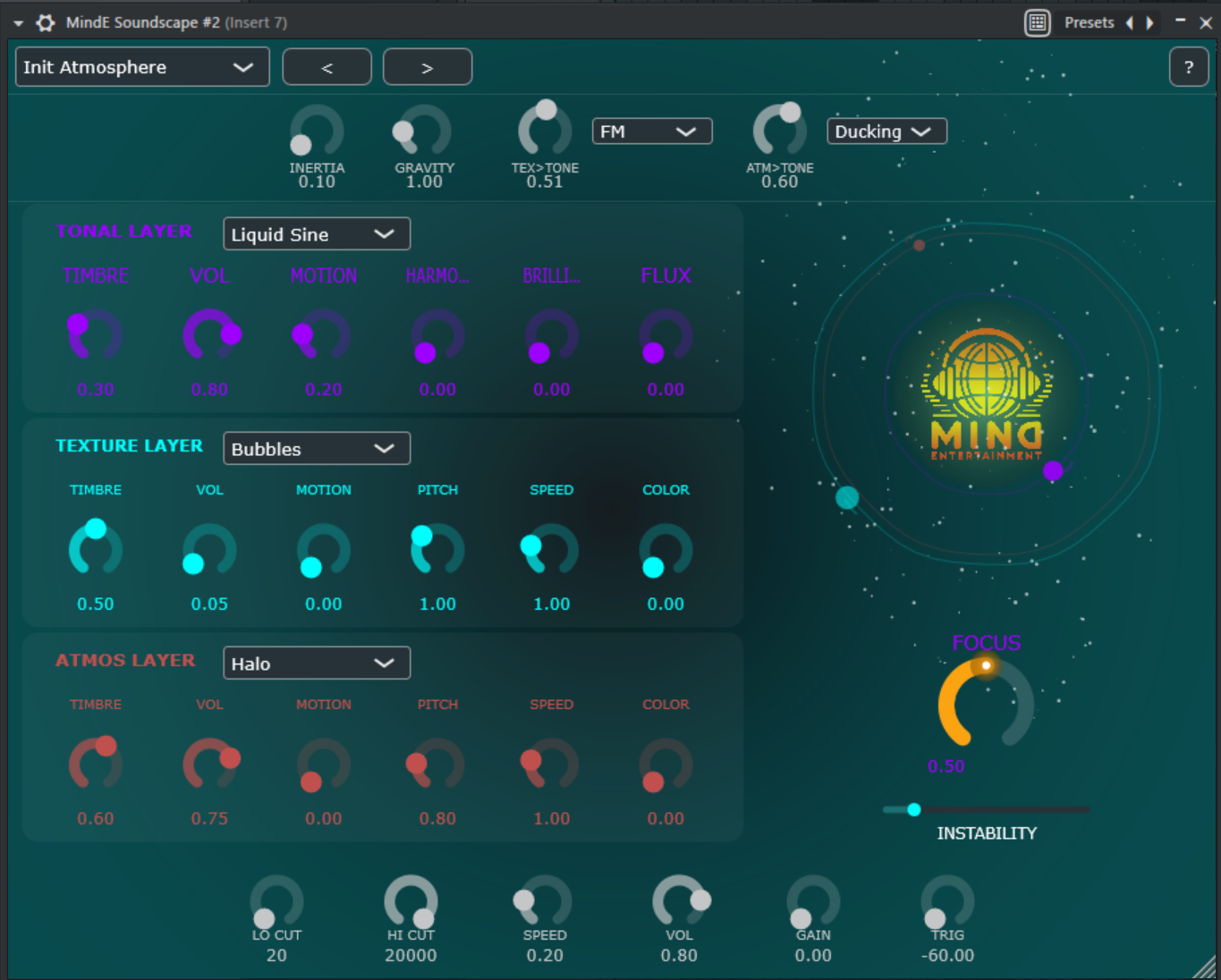
1. Philosophy: Volume through silence
Welcome to Mind Soundscape. This is no ordinary synthesizer. It was not built to play leads or basses, but to weave vivid atmospheres.
The core concept is based on "endogenous synthesis":
-
Sound is created through texture, drift, and interaction.
-
A sound is never static; it "lives" like an organism.
-
Symbiosis: The noises (rain, crackling) are not just accessories—they create and transform the musical tone.
The "Orbital Engine"
Imagine a solar system. Three planets orbit around a core and influence each other:
-
Tonal (body): The musical core.
-
Texture (matter): Physical details (dust, mechanics, glitch).
-
Atmos (space): The environment (wind, reverb, city noise).
2. The sections in detail
A. PHYSICS & SYMBIOSIS (The core)
Here you define the physical laws of your sound world.
The envelope (Physics):
-
INERTIA (Inertia / Attack): How heavy is the sound?
-
Low: The sound starts immediately (light).
-
High: The sound takes time to build up energy (massive).
-
GRAVITY (gravity / release): How long does the sound remain in the room?
The symbiosis (Advanced Routing):
Here you connect the layers with each other. This is the key to complex sounds.
-
TEX > TONE (knob): How strongly does the texture influence the tone?
-
TEX ROUTING (dropdown): What does the texture do to the tone?
-
FM: Frequency modulation (roughness).
-
AM: Amplitude modulation (tremolo/chopping).
-
Timbre: Modulates the timbre.
-
FilterFM: The texture controls the master filters (wild!).
-
Bitcrush: The texture reduces the audio resolution (lo-fi).
-
Panic: Random, chaotic pitch jumps (glitch).
-
Resonance: Generates feedback in Karplus mode.
-
ATM > TONE (knob): How strongly does the atmosphere influence the tone?
-
ATMOS ROUTING (dropdown): What does the atmosphere do?
-
Ducking: The sound becomes quieter when the atmosphere is loud (sidechain).
-
Haze: Slight detuning (chorus/drift).
-
Blur: Softens the overtones.
-
Gater: The sound is only heard when the atmosphere is active.
-
Drive: Distortion based on Atmos level.
-
Freeze: Freezes the sound (infinite sustain).
-
UniVibe: Phaser effect.
B. TONAL LAYER (The Body)
New parameters in V13 allow for precise sound design.
-
MODE: 32 generators (see appendix).
-
TIMBRE: The main sound shaper (Morph).
-
VOL: Volume.
-
MOTION: LFO movement.
-
HARMONICS (New): Adds an octave or harmonic overtones. Makes the sound "fatter" and more organ-like.
-
BRILLIANCE (New): An "exciter" for the high frequencies. Adds air and sparkle (parallel saturation).
-
FLUX (New): Organic "random walk." The pitch drifts unpredictably, like an old, broken device.
C. TEXTURE LAYER (The Detail)
Now with full control over time and pitch.
-
MODE: 24 physical models (vinyl, rain, violinist, keyboard...).
-
TIMBRE: Density/hardness.
-
PITCH: Playback speed of the texture (deep rumble <-> high-pitched hiss).
-
SPEED: How often events occur (raindrops per second).
-
COLOR: Tilt filter (dark <-> light).
D. ATMOS LAYER (The Space)
-
MODE: 24 environments (space, subway, forest...).
-
PITCH: Mood of the atmosphere.
-
SPEED: Speed of modulation (wind speed).
-
COLOR: Tilt filter.
3. Global Controls (Footer)
-
LO CUT / HI CUT: Master filter for cleaning up the mix.
-
ORBIT SPEED: How fast do the planets (LFOs) move?
-
FOCUS: The macro control.
-
Left: Dream state (atmosphere and reverb dominate).
-
Right: Microscopic proximity (texture & details dominate).
-
INSTABILITY: (Note: logic reversed from before!)
-
0% (left): Clean, hi-fi.
-
100% (right): Destroyed. Tape warble, dropouts, drift.
-
GAIN: Output boost (+12dB) for very quiet ambient patches.
4. Visualization
The interface comes to life:
-
Dynamic Core: The "sun" in the middle changes color from orange to cyan based on the FOCUS.
-
Star Dust: Particles in the background react to the audio energy.
-
Trails: The planets leave trails of light to make their orbits visible.
-
Glitch: At high INSTABILITY, the entire interface begins to "wobble" visually.
5. Pro tips (advanced sound design)
-
The "Freeze" Pad:
-
Select a nice tonal sound (e.g., Glass Chime).
-
Set Atmos to Wind or Shimmer.
-
Select Atmos Routing: "Freeze."
-
Turn up ATM > TONE.
-
Effect: As the atmosphere swells, the sound freezes and forms standing soundscapes.
-
Rhythmic destruction:
-
Select Texture Clock or Gears (rhythmic).
-
Set Tex Routing to "Bitcrush" or "FilterFM."
-
Effect: The sound is chopped up and distorted in time with the mechanical noises.
-
Vintage Tape:
-
Tonal: Mellotron-like sounds (Add Organ or Strings).
-
Flux: 30% (for slight drift).
-
Instability: 40% (for wow/flutter).
-
Texture: Tape hiss.
-
Routing: No symbiosis necessary, use the global filters (Color) to make it sound "old" and muffled.
Appendix:
TONAL (32 modes):
-
New: Neuro Bass (Reese), Spectral Frozen, Shepard Tone (infinitely rising).
-
Instruments: Kalimba, Sitar, Steel Drum, Harp.
-
Keys: FM Rhodes, Wurli, Music Box.
TEXTURE (24 modes):
-
Liquid: Bubbles, Stream, Drip (Cave), Waves.
-
Mech: Typewriter, Gears, Switch, Camera.
-
Electric: Sparks, Broken Cable, Glitch.
ATMOS (24 modes):
-
Civilization: City, Factory, Server (Fan), Train, Subway.
-
Nature: Forest, Jungle (Bio-Chirps), Thunder.
-
Emotion: Angels (choir), Healing (432Hz), Horror (dissonance).