
MindE Acid Chad
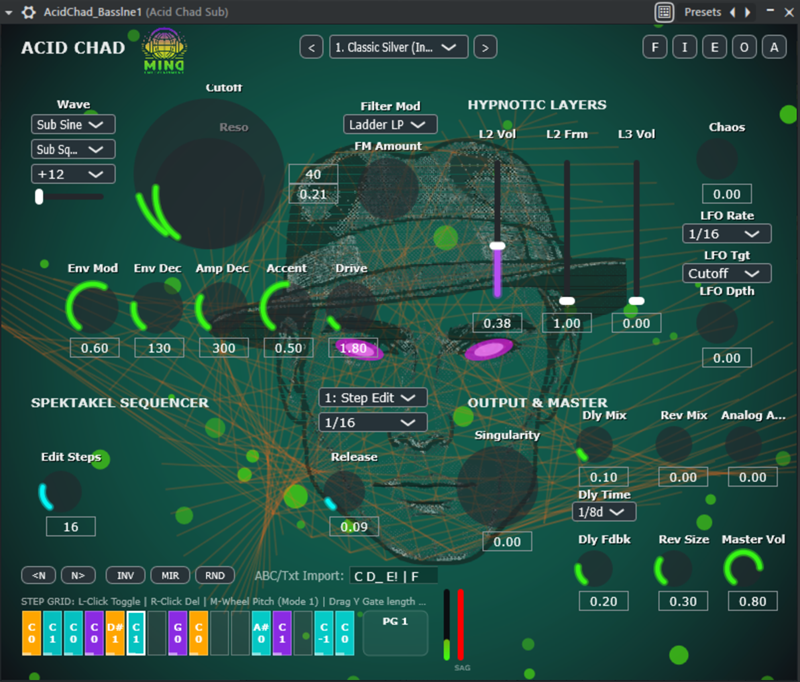
MindE Acid Chad is more than just a simple 303 emulation. The Acid Core forms the center of the instrument: a direct, fast sound section for Cutoff, Resonance, Envelope Mod, Decay, Accent, Drive, Filter Mode, Secondary Oscillator, and Core Style. This creates classic Silver Box lines, rubbery Rubber Acid sequences, hard techno patterns, Freetek loops, dubby basslines, and aggressive rave sounds.
The integrated Spectacle Sequencer is designed for movement. In addition to Step Edit, Euclidean Patterns, and Arpeggiator, Turing Machine, Polyrhythmic, Pure Acid, and Cellular are available. With Swing, Release, Slides, Accents, Rotation, Pattern mutations, Scale Matrix, and Line Gen, instantly usable Acid lines can be generated and then manually refined.
For sound design, Acid Chad expands the classic Acid approach with modern digital and hybrid timbres: Acid Saw, Dirty Noise, Super Saw, Folded Tri, Sync Saw, VOSIM, and AM Ring complement the classic waveforms. A second oscillator with Tune options, Osc Mix, FM Amount, LFO, Delay, Reverb, and Singularity Macro extends the plugin from dry 303 Squelch to dark Event Horizon drones.
Acid Core
The Acid Core is built for quick results and efficient work. Cutoff, Resonance, Env Mod, Env Decay, Amp Decay, Accent, and Drive respond directly and are tailored to the typical Acid workflow. The Core Style gives the sound generator a direction:
LINE GEN writes a new Acid line into the Step Edit context so it can be edited directly afterward. The Drop Button generates additional performative Acid drops. This creates a workflow that not only sounds random but quickly leads to usable basslines.
Spectacle Sequencer
The sequencer is a central creative section of the plugin. It combines classic step programming with generative and performative modes:
- Euclidean for rhythmic hit distributions
- Step Edit for manual 64-step patterns
- Arpeggiator with Up, Down, Up-Down, Random, In-Order, and Chord
- Turing Machine for controlled randomness
- Polyrhythmic for shifted pattern lengths
- Pure Acid for stylized Acid line generation
- Cellular for rule-based sequences
Additional performance features:
- Swing for more organic groove shifts
- Slides and Accents for typical 303 phrasing
- Nudge Left and Nudge Right
- Invert, Mirror, and Random
- Line Gen for new playable Acid lines
- Copy to Step for editable generator results
- Scale Base and Custom Matrix for tonal material
- 32-step Undo/Redo for the entire pattern (keyboard shortcuts Ctrl/Cmd+Z and Ctrl/Cmd+Y)
- Session export and import as .chad file (complete parameter and pattern state)
Sound Engine
Acid Chad combines an Acid-oriented synthesis engine with extended sound sources:
Oscillator waveforms:
- Saw
- Square
- Sine
- Triangle
- Noise
- Pulse 10%
- Pulse 25%
- Acid Saw
- Dirty Noise
- Super Saw
- Sub Sine
- Folded Tri
- Sync Saw
- VOSIM
- AM Ring
Second Oscillator:
- Off
- Sine
- Square
- Saw
- Triangle
- Folded Tri
- Sync Saw
- VOSIM
- AM Ring
Filter Modes:
- Ladder LP
- SVF Bandpass
- SVF Highpass
The combination of Resonance, Envelope Modulation, Accent, Drive, FM Amount, and Secondary Oscillator makes Acid Chad flexible enough for classic mono basslines, dark rumble textures, metallic FM arps, modern rave sounds, and experimental sequences.
Hypnotic Layers
The Hypnotic Layers expand the Acid Core with additional movement and depth. Layer 2 Volume, Layer 2 Formant, Layer 3 Volume, and Chaos Intensity create organic, metallic, or unstable additional colors. The tempo-synchronized LFO can modulate Cutoff, Osc 2 Tune, or Osc Mix.
More information in the folder with the VST3 file in the detailed product description.