
MindE Monk
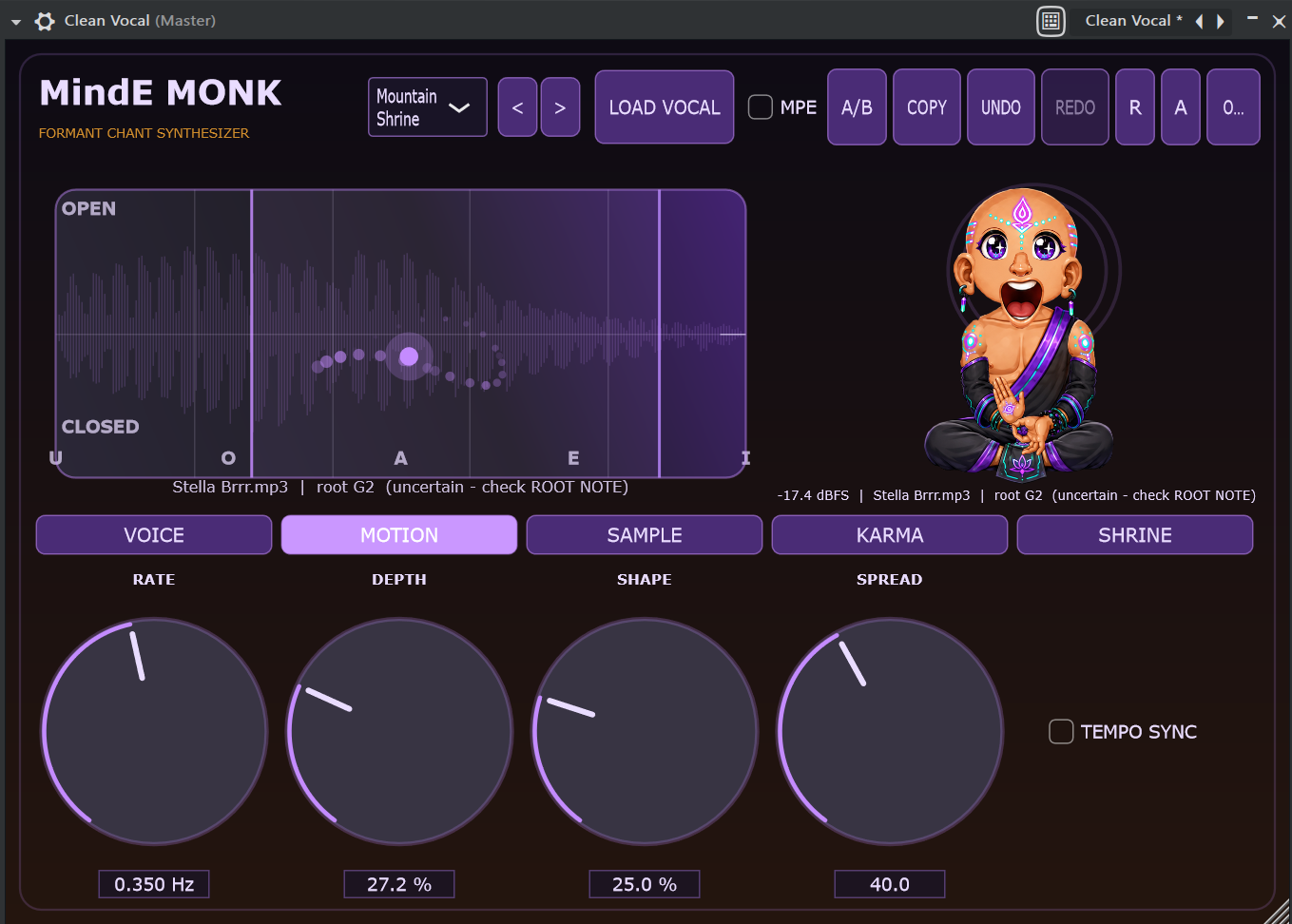
MindE Monk is a synthesizer for sung, spoken, and noisy vocal sounds. Instead of mixing waveforms, Monk builds a voice as a real one is created: a glottis generates the excitation impulse, a formant bank shapes it into a vowel, breath and onset noise are added before the bank, and an envelope gives it a body. The result ranges from deep Tibetan throat singing to choirboy vocals to whispering, barely tonal textures.
In addition, there is a second, equally important sound source: a sampler for your own vocal recordings. Monk loads vowels, syllables, or entire phrases and plays them either classically transposed or pitch-synchronously - in the latter case, the vowel color remains while only the pitch changes. Both sources can be blended continuously, so a personal take can lie beneath the synthetic monk or vice versa.
TWO SOUND SOURCES, ONE INSTRUMENT
The SOURCE switch decides what Monk plays:
- Synth: the internal voice modeling
- Sample: the loaded recording
- Layer Blend: both simultaneously, with BLEND as the mixing ratio
Both sources go through the same signal path - formant bank, Karma saturation, echo, Shrine hall - and share envelope, vibrato, glide, and motion control. An imported vowel is not simply played back but performed: with velocity, portamento, vibrato, and vowel morphing like any other note.
THE VOCAL PAD
At the center of the interface is a two-dimensional vocal field:
- X morphs through the vowel series U - O - A - E - I
- Y morphs from a closed to an open articulation
This is not a knob with an added brightness control, but a real surface: for each position, four formant frequencies are interpolated from two tables. A diagonal move across the pad sounds like a mouth opening and changing the vowel position, not like a filter sweep.
The same pad displays the waveform of a loaded sample and accepts audio files via drag and drop. The two loop markers can be moved directly in the waveform while the sound is playing.
MOTION: MOVEMENT WITH FOUR CONTROLS
A choir never stands still. The MOTION engine automatically moves the vocal field and several secondary targets - with deliberately few but effective controls
And above all sits an animated monk that reacts to what is currently sounding.
The basic idea came from the ancient but super exciting VST Synth: Delay Lama VST (AudioNerdz, 2004), which unfortunately was not further developed.
The complete product description can be found again in the Google Drive folder with the .vst3 file.